Skip to content

Welcome to 2026, where results from traditional search are taking a back seat to the new and flashy results from AI search. If you’ve used Google in the past year, you’ve probably noticed the “AI Overview”, that big block with text and images, appearing above the traditional search results. These new AI overviews don’t seem to be going anywhere anytime soon, so businesses and websites need to adapt and find a way to still reach potential clients in this new age of search.
If you’ve noticed a drop in organic traffic to your site, you aren’t alone. We’ve reached a point where over 60% of searches now end without the user ever clicking through to another website because the AI overview provides the answer directly on the results page. These “zero-click” searches are leading to a drop in organic traffic across the board, making it hard for businesses to stay visible.
But here’s the secret: there is a way to get your site visible in the AI overviews and AI search. At Digital Strike, we call the game plan for getting you into AI, AI Search Engine Optimization, or Generative Engine Optimization. The name of the game now is to set your site up as the expert on a topic that AI can’t afford to ignore.
Key Takeaways: The AI Visibility Brief
- Answer-First is Mandatory: artificial intelligence models look for direct, concise answers in the first 20–30 words of a section.
- EEAT is the Misinformation Filter: Google uses Experience and Expertise as a “shield” against generic AI-generated fluff.
- Add Multimodal Content to Your Content: Pages that combine text, high-quality images, and short-form video see a 317% higher selection rate for AI Overviews.
- Traditional SEO Strategy Still Matters: Technical health, mobile-friendly layout, and quality backlinks remain the foundation that allows AI to trust your site.
Adapt to User Behavior
The way people search has fundamentally changed. We’ve moved from users searching with short, general phrases like “best running shoes” to complex, multi-layered questions that are hyper-specific to that user’s circumstances, like “What are the best carbon-plated running shoes for a marathoner with wide feet and a history of plantar fasciitis?”
To improve brand visibility in Google AI overviews, your content must evolve alongside these user needs. With these complex and in-depth search queries, your content shouldn’t just answer one question; it should anticipate the next three. If you aren’t mapping out topic clusters that address the follow-up queries, you’re leaving a massive visibility gap for your competitors to fill.
To go back to our shoe example, a piece of content structured around the best shoes of 2026 would rank well for short, general queries users have searched for in the past, like “best running shoes”. Now, to rank in AI overviews for the complex and hyper-specific searches, your content will need to cover all of the other sub-topics that a user could ask about. This means writing a blog post that covers the best shoes of 2026, the best shoes for people with foot issues like plantar fasciitis, the best shoes under $100, the best shoes for everyday walking, the best shoes for beginner runners, etc.
Creating Unique and Valuable Content
In an era where the internet is flooded with content for the sake of content, original insights are your greatest asset. Google’s algorithms are now highly sensitive to promote these pieces of non-commodity content. These pieces of content are valuable to Google because they contain information that a large language model (LLM) like Gemini or ChatGPT can’t easily replicate.
To successfully create valuable content that LLMs can’t replicate, create content using Google’s EEAT guidelines. EEAT stands for Experience, Expertise, Authoritativeness, and Trustworthiness. These are the criteria that Google uses to judge your content. To meet these criteria when writing, you need to show how you have experience in the subject matter, that you are an expert on the subject matter, that you are an authority figure in the field regarding the subject matter, and that you are a trustworthy source. Your entire content strategy should be built around these 4 pillars. To understand how Google judges your website’s content, read our blog about the EEAT guidelines.
- Focus on the First “E”: Experience. Don’t just tell the AI what something is; tell it how you used it.
- Bring something new to the table: Use original research, case studies, and unique data points. AI loves primary sources because they provide new information to the knowledge graph.
- Proper Segmentation: Every paragraph of your content should be of value. If the AI extracts one block of your text, does it still make sense and provide a complete answer?
Create Supporting Multimodal Content
Multimodal content is content that combines 2 or more content mediums to convey a message such as text combined with videos or images. Adding these types of content makes a piece of content, like a blog, more engaging and accessible.
While AI still primarily relies on pulling text for citations and understanding, adding these pieces of content will improve your chances of being seen as the most useful version of the answer to user queries. This is because the AI will believe that your content is the most accessible and easy to digest for users.
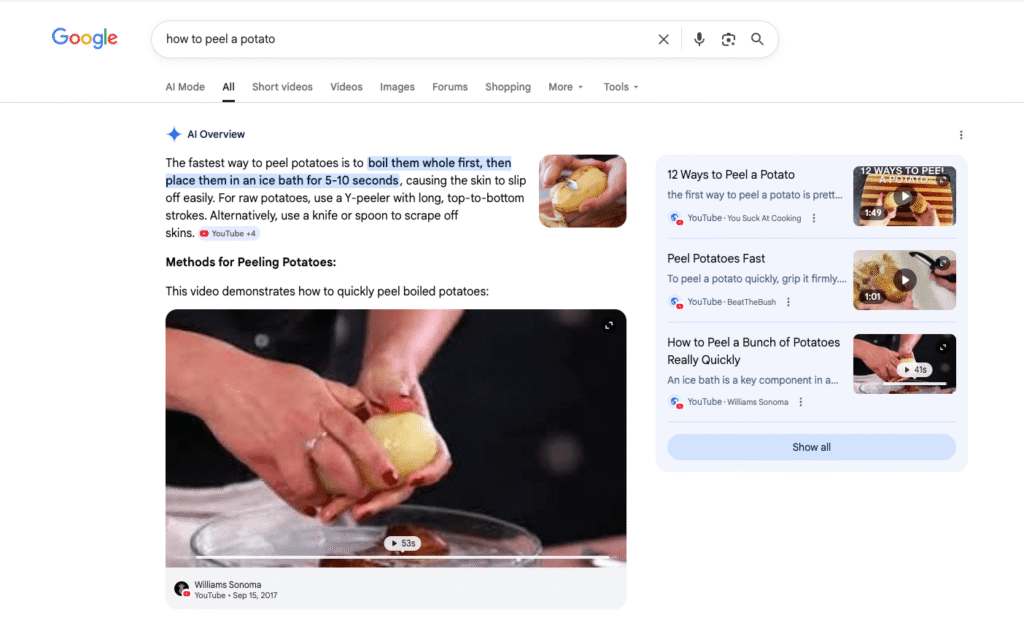
To establish yourself as the most useful version of the answer, you should integrate high-quality images, infographics, and short-form videos (60–90 seconds) into your pages. An example of being the most useful version of the answer is when an AI summarizes a “How-To” guide; it significantly favors pages that provide a video transcript and visual steps alongside the text. It would add these visuals to the AI overview, improving your overall visibility. The example below shows how a “how-to” video is displayed in the AI overview:
Make Sure Your Content is Accessible
You can have the best content in the world, but if Googlebot can’t crawl it efficiently, you’re invisible to the AI overviews. To improve your visibility, you need to make your site accessible to these AI agents so they can read and crawl it.
- Crawlability: Ensure your site returns a clean HTTP 200 status code and your navigation is logical. A messy site architecture or orphan pages (pages with no internal links) makes it difficult for AI crawlers to understand the relationship between your topics and pages. This throws the AI agent off and could cause it to fail to establish you as a subject-matter expert, or worse, to give up and leave your site.
- Indexing: AI Overviews pull from indexable content that is easy to parse. Avoid hiding your best insights behind complex JavaScript or “Read More” buttons that the AI might skip; if it’s not in the HTML on page load, it might as well not exist for the AI summary.
- Semantic HTML: Use proper headings (H1, H2, H3) to create a clear hierarchy and order to your content. This helps the AI understand the context of each section, making it significantly easier for the AI to take and reference your content for an AI Overview citation.
Add Structured Data to Your Content
Structured data is a specific type of code, usually in JSON-LD format, that you add to your website to help search engines understand your content. While humans read the text on your page, AI agents read this code behind the text to identify “Entities”—the specific people, products, and locations connected to your brand.
This technical layer behind your content allows Google to categorize your information accurately within its global knowledge graph. Being properly categorized in the knowledge graph helps Google reference and cite your information in SERPs and AI overviews.
To ensure your site is ready for AI discovery, focus on these three technical steps:
- Implement Specific Schema: Use Schema.org tags that match your content type, such as Article, FAQ, or Product. Providing this data increases the likelihood that your site will appear in rich results, which are the primary data sources Google uses to generate AI Overviews.
- Validate Your Markup: AI systems require precise information to cite a source. Use validation tools, like the ones on Schema.org, to check your code for errors, ensuring it meets Google’s latest guidelines so your data is not ignored or misinterpreted.
- Identify Your Experts: Use markup to clearly define the authors and experts behind your content. This provides the proof of experience that the AI needs to trust your site as an authoritative source.
For a deeper dive into schema markup and structured data, read our blog on schema markup here.
Optimize Your Page Experience
User experience remains a core ranking factor for both classic search results and AI-driven ones. If your site has any issues with load times or poor device compatibility, Google is unlikely to recommend you as a source. This is because Google doesn’t want to send its users to sites with a poor user experience. Here are a few things to keep in mind when evaluating the user experience on your site:
- Speed = Trust: A fast site signals to users and the AI agents that you are a professional, reliable source. Check your Core Web Vitals in Google Search Console to monitor load times and overall site health.
- Conversion Indicators: Ensure your navigation and forms are frictionless once a user clicks through from an AI citation. Make the conversion process and navigation as seamless as possible for users.
Measuring Performance in AI

Traditional KPIs for organic search, such as Clicks and Click-Through Rate, are becoming less important in the new age of search. The game has shifted a little from how many people you get on your site to how many people read your content. The goal of ranking in AI overviews is to get your content and brand in front of as many people as possible. To track our progress on this goal, we will need to shift the way we measure success.
Instead of clicks and CTR, metrics like impressions, AI citations, and SERP features are what you should be looking at to gauge success in AI. These KPIs give you a better idea of whether you are appearing in AI and how your content is performing with these AI agents. You can find these KPIs on SEO platforms that have AI tools like Semrush and Ahrefs.