Skip to content

Welcome to 2026, where the digital landscape is constantly changing, and you have to stay ahead of the changes to remain visible. From shifting consumer expectations to new AI tools being added to platforms every day, it’s becoming harder and harder to stay on top of everything. That’s why we’ve put together this list of the top 8 digital marketing trends we believe will impact 2026 the most to help you stay ahead of the curve.
Key Takeaways: Your 2026 Digital Strategy at a Glance
- Move Beyond Keywords to Topic Clusters: AI search and LLMs are prioritizing topical authority. To stay visible, you must move away from single-phrase targeting and build deep content clusters that answer hyper-specific, multi-layered user questions.
- The Shift from AI Tools to AI Agents: We are moving past simple prompts. AI agents in 2026 now analyze real-time data to make autonomous decisions—like adjusting email segments or reallocating ad spend—to hit your specific business goals without manual intervention.
- AR is No Longer a Gimmick: For e-commerce, Augmented Reality (AR) is a primary conversion driver. It bridges the gap between digital browsing and physical ownership by letting customers try on or visualize products in their own space.
- Authenticity Over Production: Audiences are craving UGC (User-Generated Content). Short-form, bite-sized videos and community-driven platforms like Discord and Reddit are outperforming polished corporate ads because they feel genuine and human.
- Optimize for Voice Search: Voice search is rising. Your SEO strategy needs to incorporate long-tail, conversational keywords that match how users naturally ask questions to voice assistants like Alexa or Siri.
- Own Your Data to Own the Experience: With the end of third-party cookies, first-party data is your most valuable asset. Building your own database through loyalty programs and email lists is the only way to deliver the hyper-personalized, 1:1 experiences customers now expect.
1. Search Evolution and the New SEO
How do you improve search visibility in 2026?
To rank in 2026, you must optimize your site for traditional search, LLMs, and AI Overviews by providing direct, factual answers for the complex questions users are asking. Visibility now depends on your topical authority and how well you cover each topic.
Search has exploded beyond the traditional Google blue links. A growing number of new users are now searching within LLMs like ChatGPT and Perplexity. This shift to AI search also comes with changing consumer behavior. In the past, users’ queries would be broad, like “best running shoes for men”. Within these LLMs, user queries are getting more and more precise with searches like “best running shoes for men over 40 with a history of plantar fasciitis”. These longer searches change the way you have to write content if you want to be featured. Instead of covering an overarching topic in depth, like the best running shoes for men, you have to build out topic clusters to explore the overarching topics from multiple angles.
How you cover topics is only half the battle to rank in AI; you also need to make it easy for the AI agent to read. The best way to do this is to add markup schema to your pages so these agents can process and understand your content more easily. For more about how to implement schema on your site, read this blog about the benefits of schema.
Local SEO has also shifted. Your Google My Business listings must be hyper-accurate because AI agents use them to answer voice search queries about nearby services. By focusing on long-tail keywords that reflect how people actually talk, you can capture the high-intent traffic that AI search is designed to serve.
Actionable Insights:
Write your content to cover topic clusters, addressing topics from multiple angles. This new way of writing content and covering topics will help your content answer the complex questions users are asking in AI search. Adding schema markup to your website will help your content earn citations in AI overviews and LLMs.
2. The Rise of AI Agents for Campaign Optimizations
How are AI Agents changing marketing in 2026?
Artificial Intelligence has transitioned from a tool that responds to prompts, like ChatGPT or Gemini, to AI agents that analyze information, make decisions, and adapt their strategies to achieve your objectives. This is a shift from telling the AI exactly what to do and having it follow the rules exactly, to you telling the AI agent your goals and having it analyze situations and tools to make decisions to achieve those goals.
These agents are taking over an increasing number of marketing campaigns:
- Email Campaigns: An agent launches an email marketing campaign, monitors open rates and CTR in real time. It then identifies the underperforming segments, generates new versions of the email, and sends it out again to improve performance.
- Lead Scoring: An agent identifies when a target account shows increased engagement and automatically adjusts the messaging across customer touchpoints. The agent then alerts the sales team with relevant insights and optimizes the budget allocation in real time.
- Competitor Analysis: An agent constantly scans multiple channels for brand mentions across social media, news sources, blogs, and forums to give a full picture of the conversation happening with no data lag.
AI-driven agents are becoming increasingly prevalent across most marketing activities. For example, Meta is aiming to use AI agents that can create and optimize an entire ad campaign based on just a product description and a budget by the end of 2026.
Actionable insights:
Utilize AI to help scale campaigns while keeping a focus on continually improving AI agents available to marketers.
3. Augmented Reality Grows in E-commerce
Let’s start at the beginning: what is augmented reality?
Augmented reality is the ability to integrate digital data into a real-time experience.
An example of augmented reality in action is the first-down marker in televised football games. That yellow line on the field that moves around with the line of scrimmage isn’t real; it’s added on the broadcast through augmented reality. Below is another example of a user using augmented too see what a table would look like in their space:

According to Statista, in 2025, there were an estimated 1.06 billion mobile augmented reality (AR) users worldwide, with that number expected to reach 1.19 billion in 2028. That means advertising spending on AR will increase, and brands will work quickly to integrate it into their marketing strategies.
There are many ways to use augmented reality, but the big two are entertainment (like the line of scrimmage and first-down markers on a football broadcast) and practical functionality (like testing a lipstick shade with a selfie filter before buying the lipstick itself). Combining the two can drive strong brand engagement and boost conversion rates and sales, especially among younger demographics like Gen Z, which want hyper-personalized experiences.
Actionable insights:
For e-commerce brands, integrating AR into marketing strategies may help boost brand awareness and conversion rates among younger demographics, such as Gen Z, that seek hyper-personalized experiences. Having potential customers interact with products in augmented reality makes it easier to visualize how a product works, which could lead to increased purchases and engagement rates.
4. Short-Form and Community-Driven Social Platforms Dominate
Short-form video content continues to be one of the most engaging content formats on social media platforms like Meta and Instagram Reels, YouTube Shorts, and TikTok. The popularity of bite-sized video content is driven by its ability to quickly capture attention and offer authentic, digestible user-generated content that resonates with audiences.
Because of this desire to connect with authentic and honest content, community-driven platforms are gaining momentum. More and more marketers are turning to user-generated content (UGC) to connect with customers on a deeper level because it is seen as more genuine than influencer marketing campaigns. To capitalize on UGC, marketers are reposting user-created videos, sending influencers free products in the hopes they make a video about them, or signing brand deals with creators to create organic content around their products.
Groups and niche platforms like Discord and Reddit, as well as private Facebook groups, allow users and content creators to foster deeper connections online. Marketers are tapping into these spaces to engage with loyal audiences, create exclusive content, and strengthen brand presence within smaller, more focused communities.
Actionable insights:
Large and small businesses alike can use short-form and community-driven video content in their social media marketing plans. Prioritizing bite-sized content, user-generated content, and fostering an online community among potential customers and others in your industry are actionable steps for forward-thinking social media managers.
A lot could happen next year, and we’re doing our best to expect the unexpected. Thinking about starting a digital marketing campaign for your business next year? Contact us for a free consultation.
5. Voice Search Affects Keyword Targeting
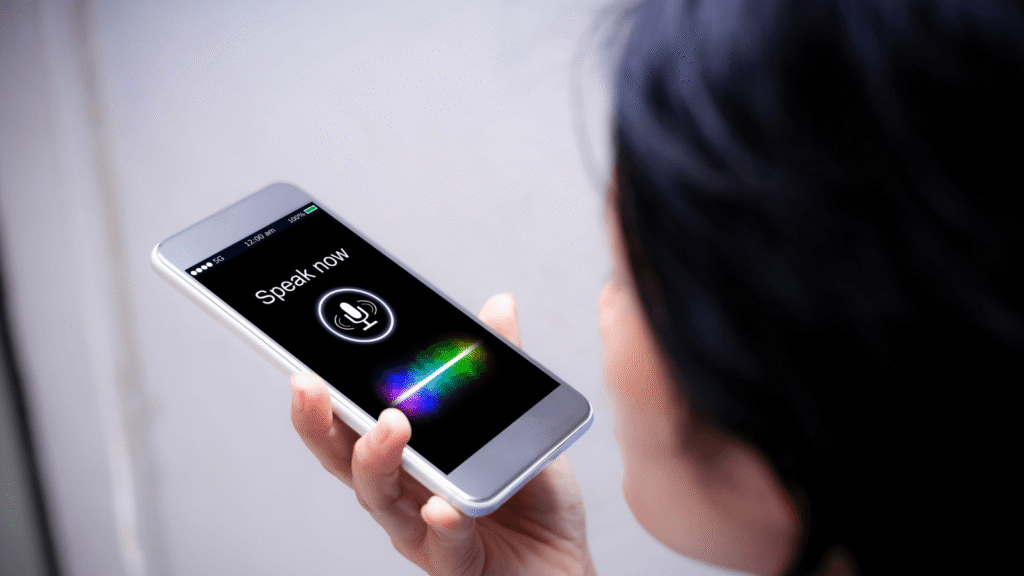
What exactly is a voice search?
Voice search happens when users ask a voice assistant, like Siri or Alexa, a question, and the assistant searches the web for an answer.
Approximately 1 in 5 people use voice search daily as of early 2026, and that number is growing. The growing number of voice searches presents a unique challenge for businesses: how can they optimize their sites to rank for these searches?
Think about how you talk out loud versus how you type. You’re probably going to speak in a full sentence rather than in a choppy phrase. If you’re asking Alexa or Siri a question, you’ll ask something like “Alexa, how do I change a tire?” Compare this to how you might ask that same question in a search bar. That same question might be phrased as “how to change a tire.”
This shift in search behavior could change how marketers optimize web pages. Instead of optimizing pages for a short-tailed keyword, it could be advantageous to target longer-tailed keywords to match these more conversational searches. This long-tailed keyword strategy will go hand in hand with the topic cluster strategy discussed above to rank in AI.
Actionable insights:
Digital marketing teams should keep an eye out in 2026 for search engine algorithm changes related to voice search and explore targeting more conversational, voice-friendly keywords.
6. Data Privacy Concerns
What is the role of data privacy in 2026?
Third-party cookies have largely disappeared due to tightening privacy regulations. What does this mean for businesses and marketers? This means that more and more businesses need to build their own customer databases through first-party data to properly target and customize user experiences.
To properly target audiences, companies are turning to initiatives such as email lists, loyalty programs, and direct community engagement to gather data and customize user experiences. It is important to keep in mind that when collecting user data, you comply with applicable regulations and are transparent about your privacy policies and security measures to build trust with your audience.
Actionable Insights:
Establish a compliant, transparent data-collection program to gain insights into your audience, customize their experience, and build customer loyalty.
7. Hyper-Personalized Customer Experience
How do you achieve hyper-personalization in 2026?
Hyper-personalized content is becoming increasingly important, as 75% of customers say they’re more likely to buy from brands that can personalize their experience. This level of personalization is achieved through dynamic product recommendations and push notifications that respond to the user’s position in the customer journey.
In the B2B world, this personalization looks like Account-Based Marketing (ABM) on steroids. By using customer segmentation and dynamic content platforms, you can treat every high-value account like a market of one. AI-based chatbots now have the memory to retain past interactions over months, creating a frictionless, deeply personal customer experience.
Actionable Insights:
As consumers demand greater personalization, marketing teams should research which customer data is required and which systems need to be established to customize their materials for each target market.
8. Social Commerce and Shoppable Content
The global social commerce market was valued at $1.64 trillion, with users buying products directly through shoppable posts and virtual storefronts on social media apps. TikTok and Instagram have become the primary malls of the world, using live chat and product demonstrations to close sales within the app. Social media has shifted from a place where users looked to gain insights into products to where they are actually purchasing them.
We are seeing a massive rise in TikTok shopping functionalities and Shopify partnerships that make checkout nearly instant. The key to success here is social listening. By understanding what people are saying in dark social (private messages and groups), brands can launch interactive content that feels organic to the social feed rather than like a traditional ad.
Actionable Insights:
E-commerce businesses should invest in social commerce, as more people use social media to make purchases. Non-e-commerce businesses should invest more in social media campaigns, given the insights these platforms offer for targeting through social listening.
Is Your Marketing Plan Ready For 2026?
The digital marketing landscape in 2026 is complex, but it is also full of opportunity for those ready to adapt. Success this year requires a balance of AI-powered automation and human authenticity. You need the technical foundation to be found by AI agents and the authenticity to be chosen by human customers.
At Digital Strike, we are seeing a massive transition in search. It is no longer enough to just show up with content. You have to be the authoritative source that AI models and human users both trust. If you have noticed your traditional organic traffic shifting, it is because the rules of visibility have changed. We are here to help you fight back with cutting-edge AI SEO strategies paired with authoritative content creation strategies that win in this new reality.
At Digital Strike – Targeted Marketing, we don’t just guess where the latest trends are going. We use data to lead the way. We help you turn these shifts into a customized digital marketing strategy built for your business goals. Connect with us today if you’re ready to stand out and reach customers in 2026.